Most people think getting good at AI means finding the right tool or memorising a few clever prompts. It doesn’t. Tools change every few months. The skill that actually lasts is knowing how to work with AI — when to use it, how to brief it, how to judge what it hands back, and how to stay responsible for the result.
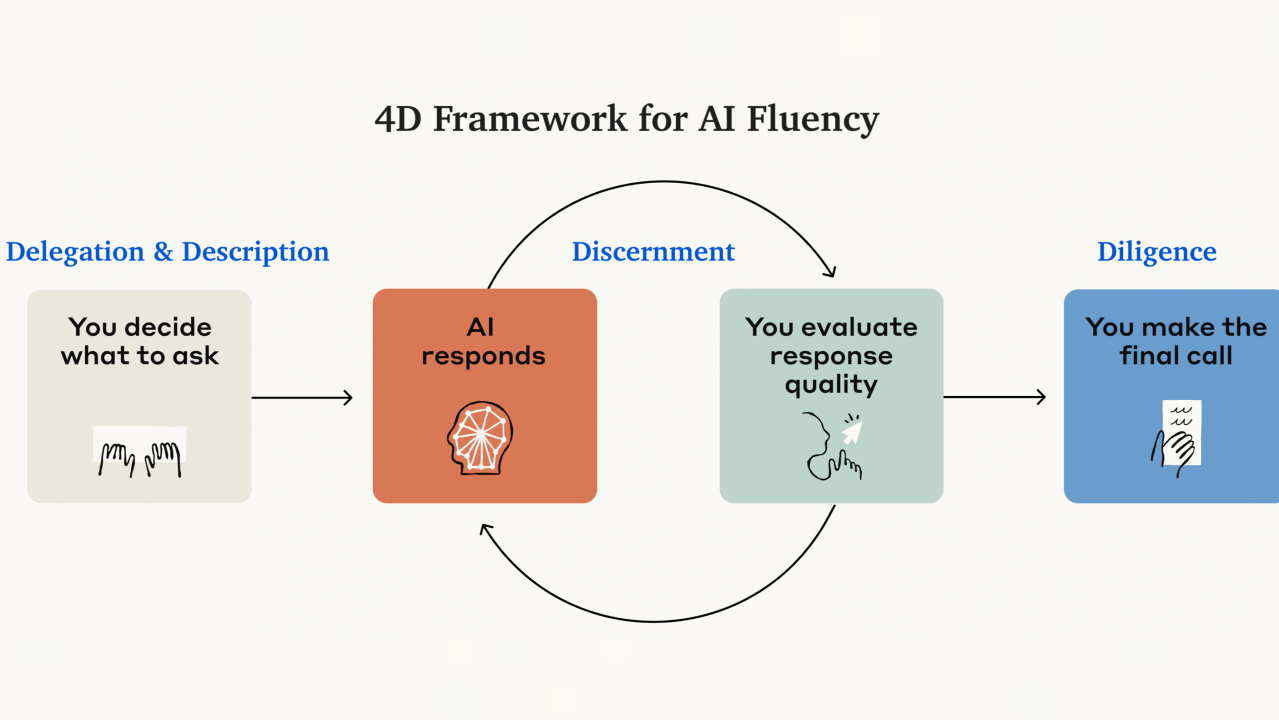
Anthropic (the company behind Claude) worked with researchers Rick Dakan and Joseph Feller to give this a name: AI fluency — the ability to work with AI effectively, efficiently, ethically and safely. They break it into four habits, neatly called the 4 Ds.
Here’s what each one means — and, more usefully, what it looks like day to day in a real business.
1. Delegation — knowing what to hand over
Delegation is deciding which parts of a job to give to AI and which to keep for yourself. It’s a balancing act between getting things done faster and keeping the bits that genuinely need your judgement.
What it looks like in practice:
- You can look at a task and split it sensibly — “AI drafts this, I decide that.”
- You know which tools are actually suited to the job, rather than reaching for the same one out of habit.
- You hold on to the decisions that carry real weight — pricing, people, anything with your name on it.
The goal isn’t to hand over everything. It’s to hand over the right things.
2. Description — briefing it clearly
Description is communicating what you actually want. Anthropic reframes “prompting” as a plain professional skill: being clear. It’s the same skill that makes you good at briefing a freelancer or a new team member — and the good news is anyone can learn it.
What it looks like in practice:
- You give context, not just commands — who it’s for, what it’s replacing, what “good” looks like.
- You describe the outcome you want, not just the task.
- When the first answer misses, you adjust the brief rather than giving up on the tool.
A vague brief gets a vague result. A clear one gets something you can actually use.
3. Discernment — judging what comes back
Discernment is treating every AI output as a strong first draft, never a finished product. And here’s the catch: the better AI gets, the more this matters. As outputs become more polished, it gets harder to spot where they’re quietly wrong — so your job shifts from making the work to evaluating it.
What it looks like in practice:
- You spot when AI has confidently stated a statistic or “fact” it couldn’t possibly have checked.
- You notice when the tone is technically correct but sounds nothing like you — and you know how to fix it.
- You know which outputs to use as-is, which to edit, which to send back for another go, and which to bin entirely.
The polish is the trap. Stay sceptical.
4. Diligence — staying responsible
If delegation is about judgement, description about clarity, and discernment about evaluation, then diligence is about responsibility. It’s making sure your use of AI is honest, ethical and appropriately careful.
What it looks like in practice:
- You’re open about where AI contributed to a piece of work.
- You keep track of which tools and versions you used.
- You document the collaboration when it matters — for clients, for compliance, or just for your own records.
You stay accountable for the output, because you are.
Why this matters more, not less, over time
It’s tempting to assume that as AI gets smarter, you can relax. The opposite is true. Smarter AI produces work that looks right more often — which makes the human skills of judging, checking and owning the result more valuable, not less. Fluency isn’t a phase you pass through and leave behind; it’s the thing that keeps paying off.
Where to start this week
Pick one task you’d normally do from scratch. Then run it through the four:
- Delegate — is this a good one to hand over? Which parts stay with you?
- Describe — brief it properly. Context, audience, what “good” looks like.
- Discern — read the result like a sceptic. What would you change?
- Diligence — would you be comfortable explaining how this was made?
Do that a handful of times and it stops being a checklist and becomes a habit. That’s fluency.
This is exactly the kind of hands-on, practical AI thinking we help UK businesses build at Breezi. If you’d like more like this, the Tuesday Memo lands in your inbox each week — short, useful, no jargon.
Framework adapted from Anthropic’s “4 Ds of AI Fluency,” developed with Rick Dakan and Joseph Feller. Read the original article.
Free guide
Not sure where to start?
Get the cheat sheet.
ChatGPT, Claude, Gemini, Microsoft Copilot, Perplexity, and NotebookLM. What each one is for, how to set it up, and what to do in your first hour. Plain English. Ten pages. No fluff.
Sent
Your guide is downloading.
Didn’t start? Download it manually here.
If you opted in, the next Tuesday Memo lands in your inbox on Tuesday morning.
You’ll also get the occasional email about Ai that’s actually worth reading. Unsubscribe whenever.